May 26, 2017 | romance, updates
I know. It’s Friday, and Friday is when I normally post a review of some romance novel I have recently read. But I had a wedding to attend this last week, and I had been focused on working on my next book and didn’t have something planned out for the review, thinking something I might read on the plane would inspire me.
Well, while I did read on the plane, the review never got written. Meanwhile, I decided this week that I couldn’t stand the state of my desk anymore and it needed to be cleaned. Right. Now. So on Tuesday, everything got pulled off my desk (and out from under it) and I have spent the last three days trying to reassemble my life from the pieces of that. It’s …been a process. It would help if I wasn’t currently exhausted, but that’s asking way too much.
Instead, I thought I might offer my thoughts on a topic I’ve talked about a little bit in some of my reviews. Specifically, my personal philosophy when it comes to categorizing Regency romance novels. I should be clear, this is not a classification system that I expect anyone else to embrace or use themselves, but I figure it might help you as a reader understand where I’m coming from in my reviews.

 I don’t remember when I first started reading Regency romances. Probably sometime in high school. I read every one I could get my hands on, most of which were published by Avon or Harlequin. They were fun, light reads that made me smile and encouraged my dreams of finding love and my own happy ending. A chance to escape from the pressures of school and my distinctly date-less life.
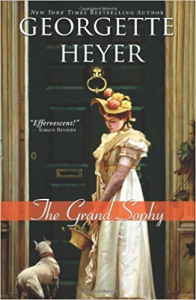
For all my explorations in the field, I didn’t discover some of the bigger authors until relatively late — probably because most of my reads were from the library or used book stores. It was a trip to Mendocino where I happened to pick up a Georgette Heyer novel (Frederica, to be precise) and first discovered her writing, devouring the book while sitting at a window table in the hotel, sipping a gin and tonic. My copy of the Grand Sophy comes from a small bookstore in Salzburg, thoroughly enjoyed during a long hot bath in the delightful hotel we stayed at there.
It was only after reading Heyer that I began to recognize what I consider to be the two main styles in Regency romance, a pattern I continue to observe today. It’s possible there are a few signs of a third emerging, but I’ll get to that at the end.
The first style, of course, is the one pioneered (introduced?) by Heyer. A comedy of manners, if you will, where the plot depends more on the characters and their quirks than any external factors. Heyer’s books are all what we would call clean romances today, with at most a kiss between the hero and heroine, but the style doesn’t have to be. The biggest difference, however, is the extent to which suspension of disbelief is required for the plot to work. (In general, it’s not.) Books in this style tend to stay closer to the norms of Regency behavior. The hero and heroine are both going to be members of the upper class. Social mores are more closely observed.
 The second style is the more common, what I would think of as the more “modern” Regency romance. You’re far more likely to find a hero or heroine who wouldn’t feel out of place in our modern society and far more awareness of contemporary issues like PTSD (for men who served in the Napoleonic Wars, for example) or women’s rights and how restricted they were during the Regency period. Spicier sex scenes and female empowerment are the norm, and the plot typically has more external drivers. It’s not uncommon to find heroes serving as spies or heroines disguising themselves as courtesans or young men to solve a mystery. Of course, all of this requires some suspension of disbelief by the reader when it comes to comparison with the known social mores of the day — the further the deviation, the more is asked of the reader. I actually tend to think of most of the books in this category (and just to be clear, I believe this is where my books fall too!) as taking place in a shared alternate history, one co-created by the authors and the readers for our mutual enjoyment. Of course, it’s not for everyone, but this gives us a space to explore characters and plots that wouldn’t be possible in the first style of book.
There are a few books that defy classification, of course. Books where the author has taken pains to stay within the realm of historical accuracy even while pushing for more modern concepts. Courtney Milan comes to mind as an author who does this particularly well, although I’m sure there are others.
I happily read both, of course. I write what I consider to be the second style, in part because I in no way believe I could do the first style justice (Heyer sets a high bar!) and in part because the plots that I want to write fall more in that direction. But maybe this helps explain why some books are very much your style while others aren’t quite. Let me know if it does!
May 19, 2017 | reviews, romance
 Biweekly marriage proposals from men who can’t see beyond her (admittedly breathtaking) looks are starting to get on Lady Clara Fairfax’s nerves. Desperate to be something more than ornamental, she escapes to her favorite charity. When a child is in trouble, she turns to tall, dark, and annoying barrister Oliver Radford.
Though he’s unexpectedly found himself in line to inherit a dukedom, Radford’s never been part of fashionable society, and the blonde beauty, though not entirely bereft of brains, isn’t part of his plans. But Clara overwhelms even his infallible logic, and when wedlock looms, all he can do is try not to lose his head over her…
It’s an inconvenient marriage by ordinary standards, but these two are far from ordinary. Can the ton’s most adored heiress and London’s most difficult bachelor fall victim to their own unruly desires?
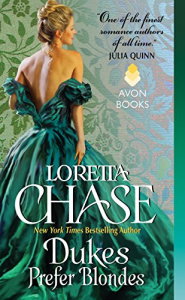
Dukes Prefer Blondes, by Loretta Chase
Finally, we get to Lady Clara’s story. We met her in the first book of the series, when Marcelline was determined to dress her as the future Duchess of Clevedon — only for her to tell off Clevedon because she deserved someone who loved her for herself. In Sophy’s story, Clara was nearly trapped into marriage with a fortune hunter, attempting to run off on her own instead of giving in to Society’s dictates. She moves off to the wings in Leonie’s story to allow Lady Gladys, her cousin, a chance to shine, but she’s still there, still unmarried. Still looking.
And now it’s her turn.
I will admit I am biased here, because I like Lady Clara a lot, but I could see where she might not be everyone’s cup of tea. She speaks up for herself in the first book but then seems to suffer a setback in the second, becoming more reactive. I think that’s a natural outgrowth of her attempts to assert herself more but not necessarily having the world experience to do so in a sensible fashion, but it might irritate some readers. Certainly, the Clara we see in this book is intelligent and well aware that her knowledge is lacking in several key areas.
In a lot of ways, I think Oliver Radford is the perfect match for her. Yes, tact is not something he bothers with all that much — but he is smart enough to give Clara the respect her intelligence deserves (once she’s proven its existence to him). He might not be intimately familiar with the limitations Society has placed on her, as an unmarried female of rank, but he does listen to her when she describes them. (It might take a bit to sink in, as he is still a gentleman, but he offers her far more respect than any of her other suitors have.)
Because of that, I can’t really blame Lady Clara for falling for him. I certainly enjoy the banter between them as well, even if some of the plot struck me as a little far-fetched. We do see a little more of the Noirot sisters, although their part is kept to a minimum. The dress descriptions are still there despite that (hooray!) and the new secondary characters we meet are all fine, if unremarkable. The focus is definitely on Clara and Oliver and I enjoyed it.
For me, this is probably tied with the first book of the series for overall enjoyment, behind the third but ahead of the second. As always, your mileage may vary, especially depending on how you feel about tradition in Regency and your willingness to suspend disbelief for some of the more modern aspects of the plot. Still, it was a very satisfying conclusion to the series for me and I really enjoyed meeting the Noirot sisters and Lady Clara.
If only I could get a dress by them!
May 12, 2017 | reviews, romance
 From the Diary of Leonie Noirot: The perfect corset should invite its undoing…
Lethally charming Simon Blair, Marquess of Lisburne, has reluctantly returned to London for one reason only: a family obligation. Still, he might make time for the seduction of a certain redheaded dressmaker—but Leonie Noirot hasn’t time for him. She’s obsessed with transforming his cousin, the dowdy Lady Gladys, into a swan.
Leonie’s skills can coax curves—and profits—from thin air, but his criminally handsome lordship is too busy trying to seduce her to appreciate her genius. He badly needs to learn a lesson, and the wager she provokes ought to teach him, once and for all.
A great plan, in theory—but Lisburne’s become a serious distraction and Leonie’s usual logic is in danger of slipping away as easily as a silk chemise. Could the Season’s greatest transformation be her own?
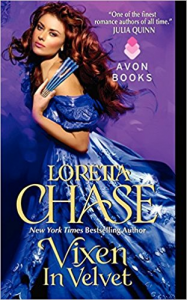
Vixen in Velvet, by Loretta Chase
This is book three of the Dressmakers series (you can find the reviews for book one and book two here as well) and I have to say that after a second book that dragged a bit, Leonie’s story was refreshing — perhaps my favorite of the three! The glorious descriptions of the dresses are back, if still not quite at the same level as in Marcelline’s story, and Leonie goes from being something of a blank slate to a determined, hardworking woman who cares about both art and others, for all that she doesn’t let the world see that side of her.
I love the way the book starts — that’s all I’ll say because I don’t want to spoil anything! — and it does an excellent job of introducing not just the hero and heroine but also the side characters who end up with important roles to play. Lady Clara is back, of course, but we get to meet the Lady Gladys mentioned in book two and she quickly becomes someone I care about. I also liked Lord Swanton, the family obligation that brings Simon to London, and how his character turns some of the normal conventions on their head.
Leonie was described in the previous book as the one with the head for business, but it becomes quickly apparent that she’s something much more than just that in this one. True, she still handles the day to day work of the shop as well as maintaining all the ledgers and making sure things run smoothly, but she also has a keen eye for understanding the customers — and her specialty is corsets, just like Sophy had her hats. I wish we got to see a little more of this, although we do spend more time in the shop this time. We also get a little more of a glimpse into the school they’ve set up for young girls, to teach them a craft, and how important that is to Leonie.
There are a few bits that feel slightly rushed or glossed over. Leonie is described as being uneasy about crowds, and it feels like the amount of time spent on the reason was very small compared to how much it affected her. Also it seemed to come and go based on how necessary it was for the story — there are places where I would have thought the crush would bother her where she was completely unaffected. Still, that’s a small quibble. Simon also is described in a way that we’re supposed to think he’s uninterested in his business stuff, until there’s a throwaway comment at the end that tries to make it seem like we were mistaken all along? I wish that had been resolved slightly better, along with a few other issues from his past that are touched on but not really explored in depth.
Despite my quibbles, I really did enjoy this one. Lord Swanton and Lady Gladys were both excellent additions to the cast. Simon does appear to think occasionally about something other than disrobing Leonie. And Leonie ends up my favorite of the sisters. She’s certainly the one I can relate to the most, I think. The book does require the normal suspension of disbelief that goes along with the whole set (see my first review for more on that) and you do definitely benefit from reading them in order but I definitely consider Vixen in Velvet to be worth it.
I’m looking forward to finally getting to Lady Clara’s story next week!
May 6, 2017 | fantasy, reviews, romance
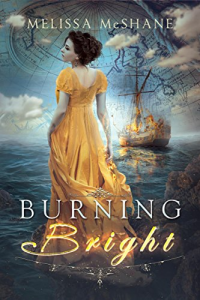 In 1812, Elinor Pembroke wakes to find her bedchamber in flames—and extinguishes them with a thought. At 21, she is old to manifest magical talent, but the evidence is unmistakable: she not only has the ability to start fires, but the far more powerful ability to control and extinguish them. She is an Extraordinary, and the only one in England capable of wielding fire in over one hundred years.
As an Extraordinary, she is respected and feared, but to her father, she represents power and prestige for himself. Mr. Pembroke, having spent his life studying magic, is determined to control Elinor and her talent by forcing her to marry where he chooses, a marriage that will produce even more powerful offspring. Trapped between the choices of a loveless marriage or living penniless and dependent on her parents, Elinor takes a third path: she defies tradition and society to join the Royal Navy.
Assigned to serve under Captain Miles Ramsay aboard the frigate Athena, she turns her fiery talent on England’s enemies, French privateers and vicious pirates preying on English ships in the Caribbean. At first feared by her shipmates, a growing number of victories make her truly part of Athena’s crew and bring her joy in her fire. But as her power grows and changes in unexpected ways, Elinor’s ability to control it is challenged. She may have the power to destroy her enemies utterly—but could it be at the cost of her own life?
Burning Bright, by Melissa McShane
Apologies this is late. It’s Friday. It’s Friday after a particularly trying week and so I went to our local fusion Mexican place to have a drink for lunch and then remembered I hadn’t written this week’s review, even though I’ve had the book picked out since I finished it on Sunday. Apparently in my brain choosing the book is equivalent to writing the review and that got checked off. Hah. Very helpful, brain.
Anyway, it should not be a surprise by now that I like things in the Regency setting. That being said, I’m not adverse to bending the rules a little bit – and in this case, the rules get bent in a very interesting way, looking at what the world might look like if there were people among us who had special powers. Think, vaguely, X-men meets Regency England, except I use the X-men comparison mostly because of the genetic component that’s mentioned in the book. (You can hardly avoid it, the heroine’s father is one of the foremost experts on the bloodlines of Extraordinaries.)
Be that as it may, I loved this book. I loved the world building. I loved the hero. I loved the heroine. I wanted more and was sad when the book was done. I went out and got the audiobook, which is a clear sign that I intend to read/listen to this again. I was curious about the different groupings of powers. I though the development was clear and straightforward. I enjoyed the plot, which still felt true to the period without being obnoxious. (It does help when you escape the rules of the London setting, as she does by having the heroine escape to Naval service. I’d be really interested to see if we can get a sequel set in London.) And I was so, so satisfied with the conclusion.
Which isn’t to say that there weren’t a few loose ends I would have enjoyed seeing wrapped up. We never get a very satisfactory answer to what happens with one of the villains (I say no more than that to avoid spoilers). I’m not 100% clear on whether a sequel will follow Elinor and Miles or focus on a new couple (and make no mistake, the first book is most certainly a romance, if not explicit). (For the record, I would be absolutely okay with a new couple, but there’s no clear “next couple” as you so often see so I’m unsure which direction the plan is to go.) Miles’ best friend is introduced but not really used much as a character, which seems a little odd. But these are all small things and shouldn’t stop you from READING THE BOOK which I highly, highly recommend if you enjoy a blend of fantasy and romance.
I suspect this book is next on my listening rotation as I work on finishing up my current needlework piece.
