Oct 25, 2017 | reviews, romance
 His life in ruins. Death, his only salvation.
After eighteen years locked in a silver cell, tortured and alone, life holds no allure for the vampire. Until her.
One touch from the beautiful human—his captor’s daughter—and Nicola’s despair turns to hope.
With her freedom at stake, will she risk it all for him?
A father should love his daughter, not turn her into a lab rat. A lifetime of “treatments” and “vitamins” has brought Evangeline endless pain—and a strength no human should possess.
Her father’s depravity knows no bounds. But before she escapes his control, she has to free Nicola.
Love to last an eternity is within reach—if death doesn’t claim them first.
Not all vampires are evil.
Not all humans are weak.
DNA doesn’t define us.
Secrets in Blood, by Patricia D. Eddy

As you might have gathered from my reviews, I’m not against paranormal romance but it’s not my favorite subgenre. I read it occasionally and my favorite romance series certainly falls into this category. That being said, however, I find that a lot of it doesn’t work for me. Vampires, for example, are not my favorite.
Still, this book had good reviews on Amazon and the price was right so I figured I’d give it a try. I’m always game for a new book, because you never know.
As the first book in a paranormal series, it starts with a little bit of world building. Vampires are governed by the Conclave. Nicola is one of the members, and helps persuade his fellow vampires to introduce a code that restricts feeding directly from humans in favor of blood from bloodbanks, where humans are compensated for their donation. This obviously cannot completely eliminate violence towards humans by vampires but does a lot to help improve relations between the two. Fast forward about 80 years and we are introduced to Henry, a scientist, and his pregnant wife. Henry is being recruited by the Hand of God, a human organization that wants to destroy vampires, to research a drug that will allow humans to more easily kill vampires. (Fire and beheading work, but vampires can heal from most other wounds and also possess superhuman strength and speed, as well as the ability to mind control humans after feeding on them.)
From there, the book hops ahead eight years to Nicola’s capture. The cell Henry leads lives underground and he’s brought his daughter, Evangeline, up to serve as bait in an attempt to catch a vampire. It’s merely Nicola’s misfortune to be in the wrong place at the wrong time and he is successfully captured. Evangeline believes he has been killed but remembers him as a nice man — far nicer than the man she calls her father.
The next several chapters of the book bounce forward through the years, giving us glimpses of Nicola in captivity and Evangeline’s growing quiet rebellion against her father and the doctrine of hate he preaches. Finally the day draws closer to when she’ll finally be able to escape — but then she discovers that the vampire she’d never been able to forget is still alive, trapped in her father’s laboratory. She can’t leave him there.
When the action finally picks up (and we stop jumping forward in time), the rest of the story takes place over roughly a week or so. There’s a reasonable amount of violence and a strong case of instant-lust on both sides. Most of the actions they take seem reasonable, and it was well written, although there were one or two spots where the speaker of dialog was very unclear.
All that said, it fell kind of in the middle for me. I was curious about what happened to Evangeline’s mother (never really explained) or what makes Evangeline so different (also never really explained). Some of the secondary characters were very flat. Events toward the end of the book happen rather fast and I was left wondering if I’d missed something significant to explain some of the character reactions. Some of this was clearly setting up for the sequel, which it sounds like will focus on Nicola and Evangeline — something to be aware of if you prefer a new couple for each book.
Still, it was a fairly solid offering so if this subgenre is your cup of tea, I’d recommend checking this one out.
Oct 18, 2017 | fantasy, reviews, romance
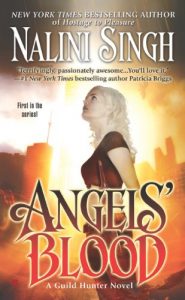 Vampire hunter Elena Deveraux is hired by the dangerously beautiful Archangel Raphael. But this time, it’s not a wayward vamp she has to track. It’s an archangel gone bad.
The job will put Elena in the midst of a killing spree like no other—and pull her to the razor’s edge of passion. Even if the hunt doesn’t destroy her, succumbing to Raphael’s seductive touch just may. For when archangels play, mortals break.
Angels’ Blood, by Nalini Singh
I’ve written before about how much I love Nalini’s Psy/Changeling series, which is why it’s odd that it took me so long to get around to reading the Guild Hunter books. You would think that my love of the one would translate into reading all of her other books. And to be fair, it does. Eventually.
Of course, like I’ve written before as well, I’m somewhat picky when it comes to my urban fantasy/paranormal romance. (I’m still not sure which of the two categories I would put this series into; the first book feels like it falls more into the paranormal romance category but the series as a whole seems to alternate between the two.) Which is why I put this one off for a while.
In the immortal world, angels stand at the top, ruled by the Cadre of Ten, a group of archangels. All angels can create vampires from humans, but demand a price of service for the gift of (nearly) immortal life. Naturally, some object after becoming vampires. Elena Deveraux was born a vampire hunter, which gives her some skills useful when tracking rogue vampires to return to their angelic masters. She’s one of the best in the Guild, which is why the Cadre hires her for a very special job.
Raphael might be one of the youngest archangels in the Cadre but he has the strength and the ruthlessness to do what needs to be done. Little of that means anything if he cannot find the rogue archangel, though — and every day Uram remains alive, the death toll rises. Elena’s gifts may be the only thing that can save the world from another Dark Age, but only if she can survive Raphael first.
This is a fast-paced book with a lot going on. It’s our introduction to the Guild Hunter universe, after all, and so there’s a lot of necessary exposition. But the plot also demands quick action by the characters and so the timeline gets compressed. Nalini’s world-building skills are in fine form and she brings a few new twists to a subgenre that is sometimes oversaturated, at least in my opinion. The focus of the story is definitely on Raphael and Elena but there are still a number of interesting secondary characters who I’m looking forward to getting to know better.
Elena is fantastic as a strong heroine who still has her moments of vulnerability. Her past is complex and we really only get a few glimpses into it, setting up some questions to be explored in later books. Raphael is also a bit of an enigma, especially since we know so little about the angels. There are hints that his past has its own tragic secrets and messy family relationships. It makes sense that as the first book of the series, there are a lot of questions unanswered at the end.
Nalini does a great job of wrapping up the important questions though, leaving the reader satisfied if still curious and anxious to read the next one. If you are like me and hesitant to read paranormal romance or urban fantasy without a recommendation, consider one given for this series. I’m looking forward to reading the second book soon.
Oct 11, 2017 | reviews, romance
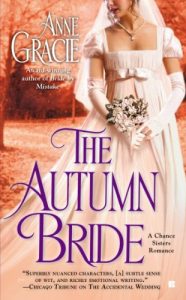 Governess Abigail Chantry will do anything to save her sister and two dearest friends from destitution, even if it means breaking into an empty mansion in the hope of finding something to sell. Instead of treasures, though, she finds the owner, Lady Beatrice Davenham, bedridden and neglected. Appalled, Abby rousts Lady Beatrice’s predatory servants and—with Lady Beatrice’s eager cooperation—the four young ladies become her “nieces,” neatly eliminating the threat of disaster for all concerned!
It’s the perfect situation, until Lady Beatrice’s dashing and arrogant nephew, Max, Lord Davenham, returns from the Orient—and discovers an impostor running his household…
A romantic entanglement was never the plan for these stubborn, passionate opponents—but falling in love may be as inevitable as the falling of autumn leaves…
The Autumn Bride, by Anne Gracie
It’s been a bit since I’ve sunk my teeth into a good, solid Regency romance. Thankfully, this was a fantastic choice. As is typical for me these days, I picked up the ebook during a sale and let it languish on my Kindle for a while. (We should not talk about the size of my unread pile in the digital space.) I’m wishing now I’d gotten to it sooner.
Be warned, reader, that as the first book of what is clearly a four book series, some time is spent getting to know all the characters and not just the hero and heroine. Indeed, the two don’t meet for quite a bit of time into the novel, as we’re preoccupied by meeting Abby and her “sisters,” along with Lady Beatrice. (Lady Beatrice, by the way, absolutely steals the show as far as I’m concerned, and is probably the character I’m most interested in following throughout the series.)
Lady Beatrice, of course, has been neglected by her servants, who have been living large on the funds that are supposed to be keeping her in luxury. Funds her nephew had arranged for before heading off to make his fortune in the southern Pacific. Word has finally trickled back to him that things may not be as they should be and so he finally decides to return to England, nine years after he left, in order to check on his aunt.
His arrival weeks after Abby has taken charge of the situation means the two of them don’t see eye to eye at the beginning. This tension lingers after the misunderstanding is resolved, in part because Max worries about what the presence of her “nieces” might do to his aunt’s reputation. Eventually it becomes impossible to ignore the attraction between them, however, and the sparks begin to fly. Of course, the path to true love is never smooth and theirs includes blackmail and an inconvenient fiancée.
The story does require you to be willing to believe that society would, for the most part, believe a polite fiction about the origin of the girls. In the modern Regency romance, this is a fairly normal level of deviation from the rules; if you’re a stickler for historical accuracy, however, you might find it to be a bit much.
Overall, while I liked Abby and Max well enough, I didn’t necessarily feel like it was their actions that resolved the conflicts in the book, some of which felt tagged on to create extra tension. The side characters more than made up for it, though. We saw just enough of Abby’s sisters to make their stories desirable, and I loved Lady Beatrice and her new butler and footman; I dearly hope we get some more of their stories in the rest of the series. Add to that the sections that I found laugh-out-loud funny and I have to recommend it for a read.
Oct 4, 2017 | reviews, romance
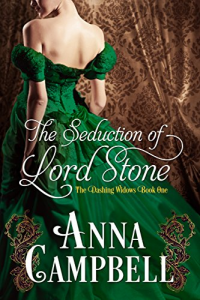 For this reckless widow, love is the most dangerous game of all.
Caroline, Lady Beaumont, arrives in London seeking excitement after ten dreary years of marriage and an even drearier year of mourning. That means conquering society, dancing like there’s no tomorrow, and taking a lover to provide passion without promises. Promises, in this dashing widow’s dictionary, equal prison. So what is an adventurous lady to do when she loses her heart to a notorious rake who, for the first time in his life, wants forever?
Devilish Silas Nash, Viscount Stone is in love at last with a beautiful, headstrong widow bent on playing the field. Worse, she’s enlisted his help to set her up with his disreputable best friend. No red-blooded man takes such a challenge lying down, and Silas schemes to seduce his darling into his arms, warm, willing and besotted. But will his passionate plots come undone against a woman determined to act the mistress, but never the wife?
The Seduction of Lord Stone, by Anne Campbell
This ended up being something of a weird read for me. The book made a fantastic first impression, introducing Caroline and her two friends, also widows, as Caroline nears the end of her year of mourning for her husband. She’s come to London in order to live her life to the fullest once she’s no longer bound by the strict rules of mourning and she resolved to make the most of it. After all, it’s her first taste of freedom after a lifetime spent living under a man’s thumb — first her father’s, then her husband’s.
The premise was intriguing and Caroline and her fellow widows are reasonably developed as characters within the first chapter. Each with a different perspective on marriage, each with a different story to tell, for all that we really only learn Caroline’s. When Caroline makes her entrance into society by hosting a ball (and we’ll leave aside a discussion of whether she would have been expected to stay in half-mourning for any time longer for those better versed in the etiquette than I am), she considers herself officially on the hunt for her first foray into the world of the physical pleasures that a wealthy widow can explore.
Of course, none of this sits well with Silas, who is the brother of one of Caroline’s fellow widows. He’s been in love with her since meeting her at one of his sister’s gatherings months back and has carefully plotted his campaign to woo her, starting by being a friend. The only problem is he’s interested in marriage, while Caroline sees that institution as nothing more than a jail sentence. After nearly scaring her off with his reaction to the news, he scrambles to maintain their friendship by offering to provide her with insights into prospective lovers, all while plotting to try and dissuade her from taking anyone other than him to his bed. Difficult, when her primary candidate is one of his best friends.
The plot from there isn’t anything out of the ordinary, but well executed and with some excellent dialog. The sexual tension between the hero and heroine is well done. In fact, I was strongly enjoying the book …when it just ended. Ended with a temporary resolution but not the happily ever after that we, as romance readers, would expect from a novel of this sort. (And I use the term novel here loosely, as based on the length of the book this is more like a novella at best.) There’s a promise that their story continues in the next book in the series, for all that this one supposedly focuses on a different hero and heroine (judging from the title) but it feels a little bit like an attempt to cheat the reader into continuing the series by forcing a cliffhanger where none is needed.
It’s frustrating too, because the writing and story was well done. I would have happily bought the next book in the series without this, but now I feel like to do so would be rewarding something I’m not comfortable with. Your mileage may vary, but I still need to think about it. Either way, reader beware that while the writing and story are good, the resolution is much more a cliffhanger than one would expect from a historical romance novel.
